The church of the Sacred Heart has a long tradition of musical excellence. Under the enigmatic Fr John Driscoll SJ (1865-1940), appointed choirmaster in 1904, the choir of boys and men (complete with choir school) gained a national reputation and sang in the first liturgical performance of the Vaughan Williams G minor Mass in Westminster Cathedral under Sir Richard Terry.

Fr John Driscoll SJ: No choirboy would dare to sing out of tune!!

To begin with, Fr Driscoll had the choir in the Sanctuary, as the original organ (by Bishop) was on the north wall of the choir (click here for the specification) and in the archive photograph above, the pipework is clearly visible on the north side of the Sanctuary. One can still see, in the wall above the door to the Sacristy, the original door to the organ loft which now leads into thin air. But, soon outgrowing the space, Fr Driscoll persuaded the parish priest, Fr William Kerr SJ, to raise funds for a magnificent new organ and west end gallery where he could place the choir.
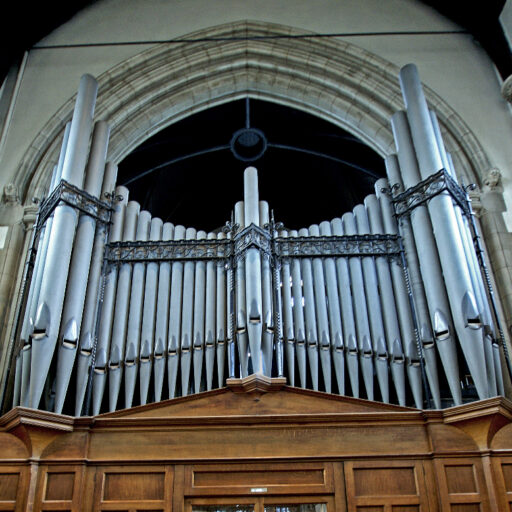
The large specification, which seems to cram in as much pipework as possible, was drawn up by Fr Driscoll’s organist, Dr Henry Wardale, who had worked with Richard Terry at Westminster Cathedral. It was built by JW Walker and Sons, was inaugurated in 1912, and remains one of the finest parish church organs in London (click here for further details). Fr Driscoll then had all he needed to create a musical tradition that received national acclaim. He spent years transcribing music by hand (some even from the Vatican Library), and often whilst hearing confession! Fr Driscoll also adapted music from other denominations (Anglican, Lutheran etc) by superimposing Latin texts.
The young George Malcolm, a pupil at Wimbledon College next door, attended some choir rehearsals at Sacred Heart, but also Farm Street, mostly taken by Fernand Laloux. Laloux was Malcom’s music teacher at Wimbledon College and Driscoll’s assistant and successor at Farm Street. Just before his death, George Malcolm told me how Fr Driscoll and Laloux’s technique of training the boys ‘in the continental manner’ was a revelation to him; it is certainly mostly responsible for the ‘Westminster sound’ that Malcolm established so brilliantly during his period at the Cathedral.
Born in Belgium, Laloux wrote liturgical music of all kinds in a highly-individual style, with piquant harmonies and lush vocal writing. He was, for fifty years, first singing teacher then Director of Music at Wimbledon College and for the three years before his death in 1970, Director of Music at the Sacred Heart. By this time, he had to have a leg amputated at the knee, but continued to play the organ and drive a car with a wooden substitute! I have met many former pupils during and after my tenure at the school who all speak of Laloux in affectionate, if not always totally respectful terms about his classroom discipline! He wrote a very fine Mass of Saint Ignatius for the boys of the College. This, and the well-known Tantum Ergo, is often performed both here and elsewhere.
The choir and choir school were disbanded at the outbreak of WW2 in 1939, and Fr Driscoll died in 1940. His sadly-neglected grave in in the Jesuit plot at Gap Road Cemetery, alongside Fr Kerr. In 1945, the choir was restarted by Fr Xavier Rogers SJ as a voluntary, mixed-voice ensemble and it remains so to this day. Subsequent directors of music have included Nicholas Danby (whose father was also organist for a time) and Colin Mawby. The strong connection with the Jesuit church of the Immaculate Conception, Farm Street, Mayfair. Fr Driscoll was, from 1928, simultaneously Director of Music at Farm Street and Wimbledon, though often delegating to Laloux. Nicholas Danby (1963-1967) and Martyn Parry (1981-1995) both left the Sacred Heart to take up the post of Director of Music there.
The current Director of Music at the Sacred Heart is Robert Rathbone and the organist and assistant director of music is David Gammie.
In addition to the choir that sings at the weekly 12pm Sung Mass, there is the Family Mass group with instrumentalists and Cantors, often with children from the Sacred Heart Primary School choir. Much of the music is home-grown, especially the Psalm settings. The 5pm Mass music group uses music from the contemporary worship-song repertoire, as well as traditional styles. We are fortunate to be able to offer styles of worship in music to suit all tastes and traditions.
We hope you will find these pages useful and informative, but most of all, we hope that you will be encouraged to join us for mass one Sunday, and perhaps many more in the future.
Music at our Weekly Masses
Saturday Mass 6:30pm: Vigil Mass has hymns with piano and Cantor on alternate weeks.
Sunday Masses:
– 10am Family Mass: led by a professional Cantor and often includes a children’s choir with piano and instrumental accompaniment.
– 12pm Sung Mass: sung Mass led by the Sacred Heart Choir and organ. The first Sunday of the month is Missa Cantare (sung Latin Mass), and all other Sundays are English Masses.
– 5pm Contemporary Music Mass: traditional and contemporary worship music led by the 5:00 choir with piano and instrumental accompaniment.
Calling All Musicians!
Do you sing or play an instrument? We’d love to hear from you! Whether you’re interested in joining the music ministry for the 10am Family Mass, the choir for the 12pm Sung Mass, or the 5pm Contemporary Music Mass, there’s a place for you to share your gifts. Contact details can be found on each page.